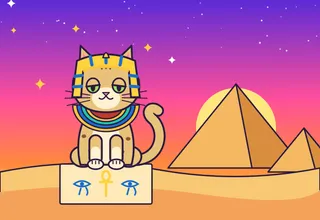
How it started
Cats moved in with people around the time people started storing grain, because grain attracts mice and mice attract cats. Archaeologists found a cat buried alongside a human on Cyprus about 9,500 years ago, which means the "I live here now" move is older than writing.
Egypt made it official. Cats kept the granaries clear and the snakes nervous, and in return they got something no animal had ever negotiated before: divinity.
Meet Bastet
Bastet began as a fierce lion-headed goddess and, over the centuries, softened into a cat-headed guardian of the home, of mothers and children, and of everyone's lunch. Her cult centre, Bubastis, held festivals that the Greek historian Herodotus described as among the biggest parties in Egypt.
She is usually shown holding a sistrum (a sacred rattle) with a basket over one arm, accompanied by kittens. This is also how most cats would like to be depicted.
The rules, as recorded by ancient historians
- Eyebrows shaved Household mourning for the family cat, per Herodotus
- Hundreds of thousands Cat mummies found at Egyptian sites
- A very bad idea Harming a cat, per Diodorus Siculus
Herodotus reported that when a household cat died, the family shaved off their eyebrows as a sign of grief. The historian Diodorus Siculus described a visiting Roman who accidentally killed a cat and was set upon by an angry crowd, even though the king's officials tried to intervene. Nineteenth-century farmers dug up so many cat mummies that a shipment was reportedly ground into fertilizer, which is a sentence every cat finds deeply offensive.
What this means for you, today
Your cat sits on your keyboard because keyboards are altars.
Your cat stares at you at 5 a.m. because the offering is late.
Your cat knocks your glass off the table because it was blocking the sun. Ra would understand.
You are not a cat owner. You are a temple attendant on a fixed-term contract.